
How to nap without sleeping too long
Count your nap from when you fall asleep, not when you lie down, and set a latest wake-up time so a short nap doesn't spill into your evening.
By the SmartNap team · · 7 min read
To nap without sleeping too long, pick a nap length, count it from the moment you fall asleep rather than from when you lie down, and set a latest wake-up time the alarm can’t go past. The first rule keeps the nap the length you chose; the second stops a slow start from pushing it into the rest of your day. When the alarm rings, give yourself a few easy minutes, because feeling groggy right after waking is normal.
Find your situation
- You set a timer and still wake up groggy
- You’re not sure how long to nap
- You take a while to fall asleep
- You have to be up by a set time
- You want to see it with real times
- You’d rather not do the sums yourself
Why naps run long
Most of us start a timer the moment we lie down. That timer counts time in bed, not time asleep. How long it takes to drift off changes from one afternoon to the next, so the same 20-minute timer can give you nearly the whole nap one day and a few minutes the next. The usual fix is to add a buffer, but on a day you fall asleep quickly, that buffer turns into extra sleep.
Extra sleep matters because sleep gets deeper the longer it lasts. NIOSH’s training for nurses on shift work notes that you reach the deepest level, slow-wave sleep, in about an hour, and that waking from it can leave you functioning noticeably worse for a while.
That grogginess has a name: sleep inertia, a temporary drop in alertness and performance right after waking. In their review of the research, Tassi and Muzet report that waking abruptly from slow-wave sleep produces more sleep inertia than waking from lighter sleep. They also note that studies have found it lasting anywhere from 1 minute to 4 hours, but that without major sleep loss it rarely goes beyond 30 minutes.
A nap that runs long also eats into what comes after it, including your night. NIOSH explains that a brief nap doesn’t disrupt sleep at night because it doesn’t reduce the pressure for sleep that builds while you’re awake, while a long nap that reaches deeper sleep can reduce it.
Step 1: Pick a length on purpose
Decide the length before you lie down, based on what the rest of your day needs rather than on how tired you feel in that moment. Here is what some of the research found:
- In a lab study of 24 healthy young adults who were good sleepers, not regular nappers, and had slept about 5 hours the night before, Brooks and Lack compared no nap with naps of 5, 10, 20 and 30 minutes of sleep at 3:00 PM. The 10-minute nap brought immediate improvements in every measure they tracked, including sleepiness, fatigue and cognitive performance, some lasting up to 155 minutes. After the 20-minute nap, improvements appeared 35 minutes later. The 30-minute nap was followed by a stretch of impaired alertness and performance, which the authors describe as sleep inertia, before improvements set in.
- In an earlier study of 12 young adults after a night of about 4.7 hours of sleep, Tietzel and Lack found that most alertness and performance measures dropped right after a 30-minute nap and showed some recovery by the end of an hour of testing, while a 10-minute nap gave an immediate improvement that lasted the hour.
- For people on a daytime schedule, NIOSH recommends a brief nap of under 20 minutes. It adds that waking after about 20 minutes, or after about 90 minutes at the predicted end of a sleep cycle, may mean less grogginess than waking after about an hour.
These are small groups in a lab. A review by Hilditch, Dorrian and Banks found mixed results on how long and how strong sleep inertia was after naps of 30 minutes or less, likely because of how much people had slept beforehand and the time of day they woke. Treat any length as a starting point and adjust it after a few naps.
Step 2: Count from when you fall asleep
Research naps are measured in sleep, not in time lying down: Brooks and Lack describe their conditions as naps of “precisely 5, 10, 20, and 30 minutes of sleep.” To get the nap you picked, the clock has to start when you fall asleep.
Without a device, you can only approximate that:
- Note the time you lie down.
- Learn your usual time to fall asleep. After a few naps, compare when you lay down with when you think you drifted off. NIOSH lists some signs that you reached light sleep: fragmented images, a sudden muscle jerk, or a feeling of starting to fall.
- Set the alarm for your lie-down time, plus your usual time to fall asleep, plus your nap length.
Our free nap calculator does that sum for you. The weak point is step 2: it’s an average, and today may not be an average day.
Step 3: Set a latest wake-up time
The second number is the latest time you must be awake: before a meeting, the start of a shift, or simply early enough to keep your evening and your bedtime intact. Decide it before you lie down, and let it overrule the nap length.
Your alarm then goes off at whichever comes first: the moment you fell asleep plus your nap length, or your cutoff. If falling asleep takes longer than usual, you get a shorter nap that ends on time instead of a full nap that ends late.
Put the cutoff a little before your real deadline. NIOSH advises letting sleep inertia wear off before critical tasks, so leave yourself some slack between waking and whatever needs your full attention.
Step 4: Make falling asleep easy
The faster you drift off, the more of the nap fits before your cutoff. NIOSH’s guidance on a good sleep environment describes one that is very dark, quiet, cool and comfortable. For a nap, that can mean:
- Dark: close the blinds or curtains, or wear an eye mask.
- Quiet: use earplugs, or a fan or white noise to cover other sounds, and silence notifications so only the alarm can wake you.
- Cool and comfortable: a light cover in a cool room, somewhere you can actually relax.
- No clock-watching: NIOSH suggests turning the clock face away so you don’t keep checking the time.
Step 5: Wake up on purpose
When the alarm rings:
- Get up. Every snooze is more sleep past the point you chose.
- Find light. In a small study of 10 young adults, the authors concluded that one minute of bright light right after a 20-minute midday nap made the nap work better against afternoon sleepiness. Washing the face right after waking reduced how sleepy people felt straight away, though the effect was mild and brief.
- Give it a few minutes. Expect some sleep inertia and start with something easy.
A worked example
You want a 20-minute nap after lunch and need to be at your desk, alert, by 2:15 PM, so you set your latest wake-up time at 2:00 PM. Here is how two different afternoons play out:
| Tuesday | Wednesday | |
|---|---|---|
| Lie down | 1:30 PM | 1:30 PM |
| Fall asleep (about) | 1:36 PM | 1:45 PM |
| 20 minutes of sleep would end at | 1:56 PM | 2:05 PM |
| Latest wake-up time | 2:00 PM | 2:00 PM |
| Alarm rings | 1:56 PM (nap length comes first) | 2:00 PM (cutoff comes first) |
| Time asleep | 20 min | 15 min |
On Wednesday you get 15 minutes instead of 20, but you’re up on time with 15 minutes to shake off the grogginess. Compare the usual timers: a 20-minute timer started at 1:30 PM rings at 1:50 PM and gives you 14 minutes on Tuesday and 5 on Wednesday. A “safe” 35-minute timer rings at 2:05 PM on both days, past your cutoff, and gives Tuesday a 29-minute nap.
How SmartNap handles this
SmartNap is an iPhone app with an Apple Watch app, built around these two numbers. You set a nap length, choosing from six presets between Power (20 minutes) and Recovery (2 hours), and a latest wake-up time. With a paired Apple Watch, the app estimates when you fall asleep: it sets a heart-rate baseline near the start, then looks for changes in heart rate, heart-rate variability and movement, and only then starts timing your nap. On iPhone alone, you start the timer yourself when you’re drifting off.
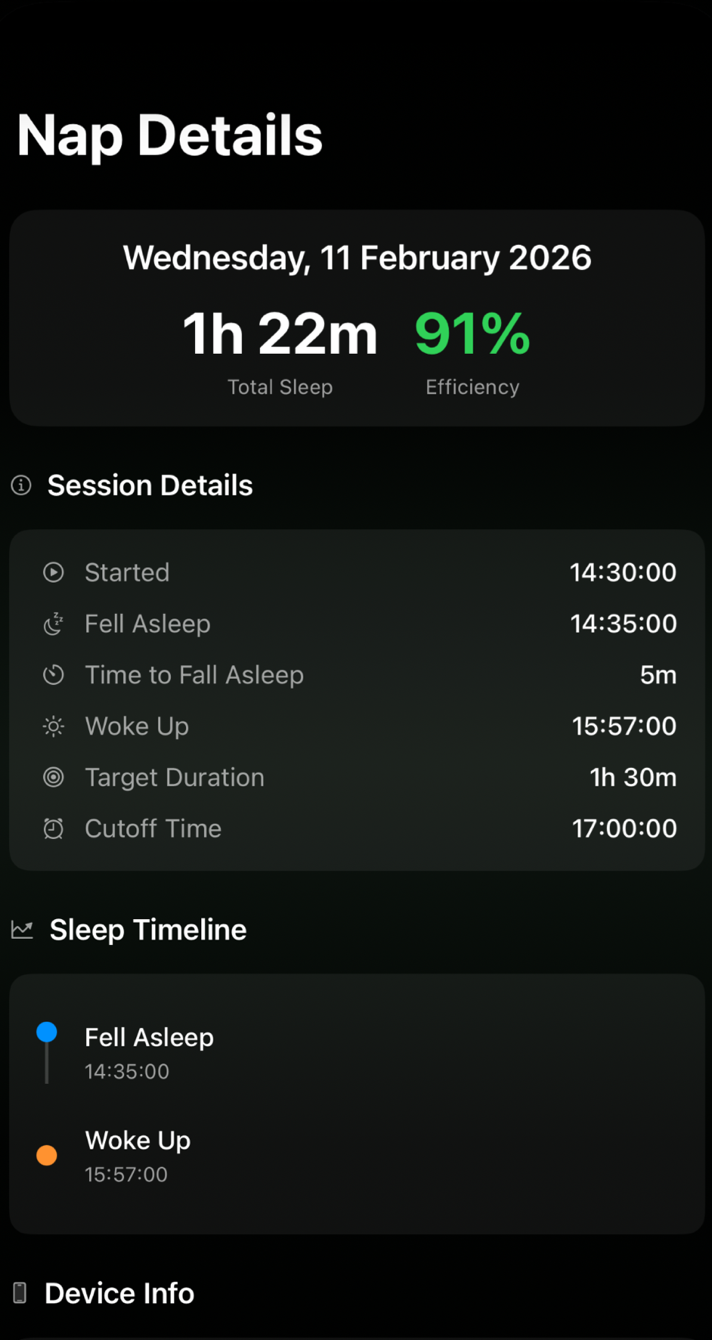
The first alarm rings at whichever comes first: your nap length counted from the estimated moment you fell asleep, or your cutoff. Snooze can take you past the cutoff, but only if you choose it. Apple Watch wakes you with taps on your wrist and optional sound. Each nap is saved with its start time, estimated time asleep, time to fall asleep, wake time, target and cutoff, plus an estimated sleep efficiency, so you can see your own time to fall asleep instead of guessing it for step 2.
It’s an estimate from your Apple Watch, not a lab measurement. Health readings are processed on your iPhone and Apple Watch. The app needs iOS 26 or later, and the automatic estimate needs watchOS 26 or later. Your first nap is free; after that, naps need a SmartNap Pro subscription.
Questions
Why do I wake up groggy after a nap?
That heavy, slow feeling is sleep inertia, a short period of lower alertness and performance right after waking. Tassi and Muzet's review reports that without major sleep loss it rarely lasts more than 30 minutes, and that it is stronger when you wake from deep (slow-wave) sleep. NIOSH notes that sleep gets deeper the longer you sleep, so longer naps make that more likely.
Should a 20-minute nap timer start when I lie down or when I fall asleep?
When you fall asleep, if you want 20 minutes of sleep. In the Brooks and Lack study, the naps were 5, 10, 20 and 30 minutes of sleep, not minutes in bed. A timer started when you lie down takes your time to fall asleep out of the nap.
Will a nap ruin my sleep schedule?
A short one is less likely to. NIOSH's training for nurses says a brief nap doesn't disrupt night sleep because it doesn't reduce the pressure for sleep that builds while you're awake, while a long nap that reaches deeper sleep can reduce that pressure. A firm latest wake-up time also keeps a nap from drifting toward your bedtime.
How do I know if I actually fell asleep during a short nap?
It can be hard to tell. NIOSH lists some signs of light sleep: fragmented images, a sudden muscle jerk, or a feeling of starting to fall.
Sources
- A brief afternoon nap following nocturnal sleep restriction: which nap duration is most recuperative?. Sleep (Brooks and Lack), 2006.
- The short-term benefits of brief and long naps following nocturnal sleep restriction. Sleep (Tietzel and Lack), 2001.
- A review of short naps and sleep inertia: do naps of 30 min or less really avoid sleep inertia and slow-wave sleep?. Sleep Medicine (Hilditch, Dorrian and Banks), 2017.
- Sleep inertia. Sleep Medicine Reviews (Tassi and Muzet), 2000.
- The alerting effects of caffeine, bright light and face washing after a short daytime nap. Clinical Neurophysiology (Hayashi, Masuda and Hori), 2003.
- Training for Nurses on Shift Work and Long Work Hours: Nap Duration. NIOSH, Centers for Disease Control and Prevention, 2020.
- Training for Nurses on Shift Work and Long Work Hours: Sleep Inertia. NIOSH, Centers for Disease Control and Prevention, 2020.
- Training for Nurses on Shift Work and Long Work Hours: Napping Before Night Shift. NIOSH, Centers for Disease Control and Prevention, 2020.
- Training for Nurses on Shift Work and Long Work Hours: Create a Good Sleep Environment. NIOSH, Centers for Disease Control and Prevention, 2020.
- Training for Nurses on Shift Work and Long Work Hours: Create a Good Sleep Environment (Continued). NIOSH, Centers for Disease Control and Prevention, 2020.
This guide is general information, not medical advice. SmartNap is a wellbeing app, not a medical device. If you’re often very sleepy during the day, talk to a doctor.
Written with AI assistance, checked against the sources listed, and published under the editorial responsibility of Sources Knight LLC.