
Nap before a night shift: how long and when
How long to nap before a night shift, when to lie down, and why a hard latest wake-up time should leave you an hour to wake up fully before work.
By the SmartNap team · · 8 min read
A nap before a night shift is usually a long one, taken in the afternoon or early evening. NIOSH’s training for nurses describes pre-shift naps of 1.5 to 3 hours that were followed by better alertness during the night than no nap at all. Whatever length fits your day, set a hard latest wake-up time that leaves at least an hour to wake up fully before work, because the grogginess after a nap can last 30 to 60 minutes or more.
Find your situation
- It’s your first night shift after days off
- You work nights regularly
- You can’t fall asleep in the afternoon
- You just want the times for a 7:00 PM start
Why a nap before a night shift helps
NIOSH calls a nap taken before the night shift a “prophylactic nap”. Its training for nurses on shift work and long work hours explains that this kind of nap is usually long, lets the brain reach deeper sleep and reduces the buildup of pressure for sleep, which can help with the drop in alertness during the night. The same page summarizes three findings, each comparing a nap with no nap:
- Nurses and nursing aides who napped for 1.5 hours (3:30 to 5:00 PM) felt significantly more alert in the second half of their first night shift.
- A 2.5-hour nap (7:30 to 10:00 PM) before a simulated night shift improved alertness during that shift.
- A 3-hour nap (2:00 to 5:00 PM) was followed by higher alertness during the next night shift.
The first finding is worth a closer look. In the original 1989 study, researchers compared 145 female shift workers, 82 of whom napped before a night shift. The nappers were significantly more alert near the end of the night shift than those who didn’t nap. The study compared workers who did and didn’t nap instead of assigning naps, so it shows an association, not cause and effect. The length and timing of the nap were not linked to alertness or performance that night.
Reviews of naps taken during night shifts point the same way, with limits. A systematic review of 13 studies found that most reported less sleepiness and better performance after a night-shift nap, despite short periods of grogginess right after waking. The studies were mostly small, and none measured safety at work. A 2021 review comparing short and long night-shift naps found 7 experiments with 140 people in total, mixed results and low-quality evidence. Its conclusion: choose the length based on how soon after the nap you need to perform, and for what.
How long to nap before a night shift
There’s no single best length. Two points from NIOSH’s page on nap duration help you choose:
- Sleep gets deeper the longer you sleep and reaches its deepest level after about an hour. Waking from that deep sleep can leave you much groggier.
- Waking after about 20 minutes, or after about 90 minutes, may mean less grogginess that clears within 15 to 30 minutes. If you start the nap very short on sleep, you may reach deep sleep sooner.
| Time between lying down and your cutoff | A length to consider | Why |
|---|---|---|
| 2 hours or more | 1.5 to 3 hours | The pre-shift examples NIOSH cites were 1.5, 2.5 and 3 hours |
| About 1.5 to 2 hours | About 90 minutes | Waking near 90 minutes may mean less grogginess |
| Under an hour | About 20 minutes | Ends before the deepest sleep |
When to nap: plan backward from your shift
- Start with your shift start time.
- Subtract the time you need to get ready and get to work.
- Subtract at least an hour for waking up. NIOSH’s page on sleep inertia says grogginess after waking typically lasts 30 to 60 minutes, has been seen to last 2 hours, and can last longer when you’re short on sleep. A 2019 review of sleep inertia adds that it’s worse after sleep loss and depends on the time of day you wake, and that full recovery doesn’t appear complete until at least an hour after waking. What’s left is your latest wake-up time: the alarm should never ring later than this.
- Pick a nap length from the table and lie down early enough to fit it, plus the time you usually need to fall asleep.
- Count the nap from when you fall asleep, not from when you lie down. If you take 25 minutes to drift off, a timer started when you lie down gives you 25 fewer minutes of nap. The rule that ties it together: wake at your nap length counted from when you fell asleep, or at your latest wake-up time, whichever comes first.
For the minutes after the alarm, NIOSH’s sleep inertia page notes that bright light and washing your face have helped people feel alert again sooner after a nap.
First night of a run
If you’re coming off days, your body clock still expects to sleep at night. NIOSH’s page on nap times says that, for people on a daytime schedule, sleep comes more easily in the afternoon, around 2 to 4 PM, and is harder to start in the evening 1 to 3 hours before your usual bedtime. So an afternoon nap is often easier to fall into than one squeezed in just before you head out. The nurses in the first NIOSH example napped from 3:30 to 5:00 PM before their first night.
You work nights regularly
Your main sleep after each shift comes first: NIOSH calls naps a temporary aid, not a replacement for a regular, long period of sleep. For the nap before the next shift, use the same backward plan: fix the latest wake-up time from your start time, then fit whatever length the window allows.
Trouble napping before a night shift
- Set up the room for daytime sleep. NIOSH’s advice for nap rooms at work is a space that’s quiet, dark, comfortable and cool, with eye masks and earplugs to block light and noise. The same conditions are worth copying at home.
- Lie down in a bed for a long nap. For naps of an hour or more, NIOSH says a horizontal surface (a bed) is preferred over a chair.
- Move the nap earlier. If you normally sleep at night, the 1 to 3 hours before your usual bedtime are a hard time to fall asleep; mid-afternoon is usually easier.
- Lie down sooner rather than shortening the buffer. A longer window means a slow start doesn’t swallow the whole nap. Keep the latest wake-up time where it is, even on days you fall asleep late.
If you’re very sleepy at work on most shifts even with naps and enough daytime sleep, talk to a doctor or your occupational health service.
Worked example: a 7:00 PM shift
Your shift starts at 7:00 PM. You need an hour to get ready and get to work, and you want an hour to wake up fully, so your latest wake-up time is 5:00 PM. You choose a 90-minute nap and lie down at 3:30 PM.
| Time | What happens |
|---|---|
| 3:30 PM | Lie down. Nap length 1 h 30 min, latest wake-up time 5:00 PM |
| 3:50 PM | You fall asleep, 20 minutes after lying down |
| 5:00 PM | Alarm. 90 minutes from 3:50 would be 5:20 PM, so the 5:00 PM cutoff comes first; you slept about 70 minutes |
| 5:00 to 6:00 PM | Wake up fully: bright light, cold water on your face, a meal |
| 6:00 to 7:00 PM | Get ready and get to work |
| 7:00 PM | Shift starts |
Two other ways the same afternoon could go:
- You fall asleep at 3:35 PM. Ninety minutes would end at 5:05 PM, so the alarm still rings at 5:00 PM, after about 85 minutes of sleep.
- You want the full 90 minutes most days. Lie down earlier, around 3:10 PM. How much earlier depends on how long you usually take to fall asleep.
To work out the times for your own shift, try the free nap calculator.
Where SmartNap fits
SmartNap is an iPhone app with an Apple Watch app, built around this plan. You set a nap length and a latest wake-up time. With a paired Apple Watch, the app estimates when you fall asleep, using a heart-rate baseline taken near the start and then changes in heart rate, heart-rate variability and movement, and starts timing from that moment. On iPhone alone, you start the timer yourself. The first alarm rings at whichever comes first: your nap length counted from the estimated moment you fell asleep, or your cutoff. Snooze can take you past the cutoff, but only if you choose it.
For the 7:00 PM example you’d pick the Deep preset (1 h 30 min), or set any length, and enter 5:00 PM as the cutoff. Each nap records when you started, when you were estimated to fall asleep, how long that took, when you woke, your target, your cutoff and an estimated sleep efficiency. After a few pre-shift naps, that history shows how early you need to lie down.
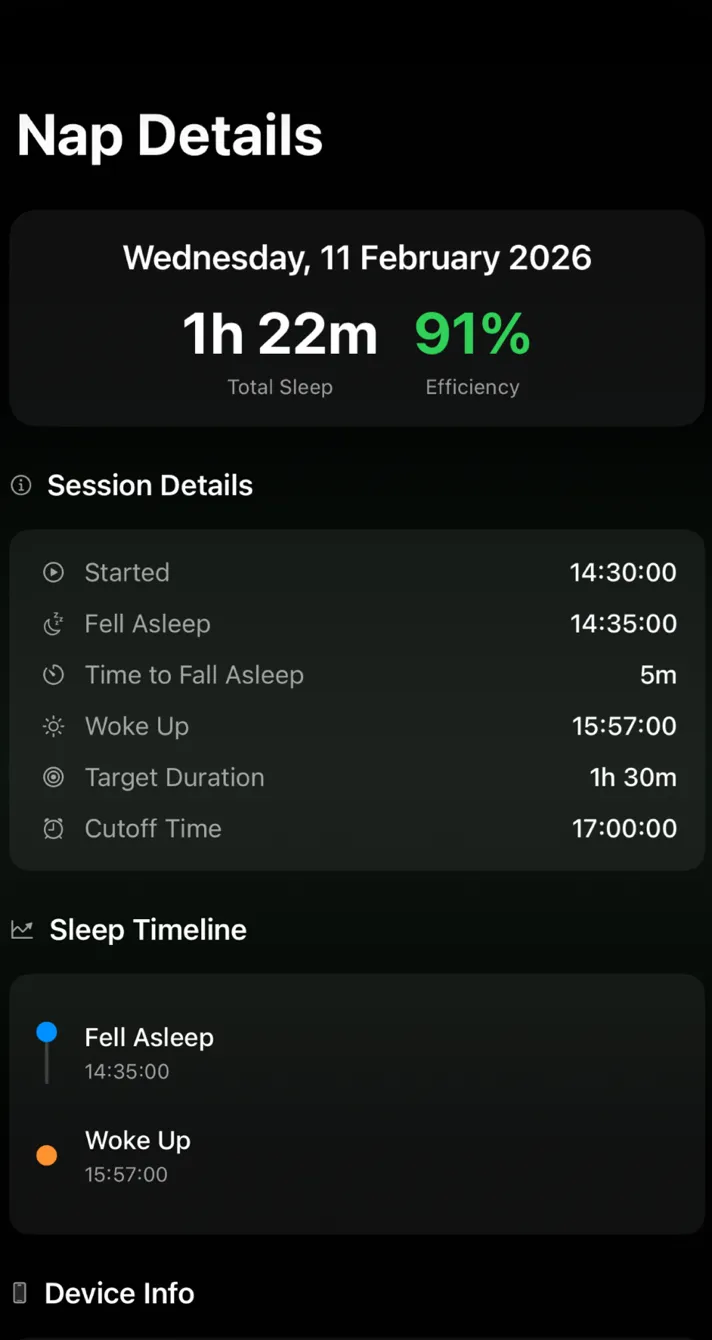
Health readings are processed on your iPhone and Apple Watch. The app needs iOS 26 or later, and the automatic estimate needs watchOS 26 or later. Your first nap is free; after that, naps are part of SmartNap Pro. The estimate can be off on any given afternoon, so treat it as a timing aid, not a measurement of your sleep.
Questions
Should I nap before a night shift?
NIOSH's training for nurses describes a nap before the night shift as a way to soften the drop in alertness during the night, and the studies it summarizes found more alertness after a pre-shift nap than with no nap. It also says naps are a temporary aid, not a replacement for your main sleep.
Is a 2-hour nap before a night shift too long?
Not by the examples NIOSH cites: pre-shift naps of 1.5, 2.5 and 3 hours were each followed by better alertness than no nap. What matters more is when the nap ends. Set a latest wake-up time that leaves at least an hour to shake off grogginess before work.
What time should I nap before a 7 PM shift?
One workable plan: lie down around 3:30 PM, aim for about 90 minutes of sleep and set 5:00 PM as your latest wake-up time. That leaves an hour to wake up fully and another hour to get ready and get to work.
What if I can't fall asleep before my night shift?
Make the room dark, quiet, cool and comfortable, try an eye mask and earplugs, and nap in a bed. If you normally sleep at night, an afternoon nap is often easier than one in the hours before your usual bedtime. Keep your latest wake-up time fixed even on days you fall asleep late.
Sources
- NIOSH Training for Nurses on Shift Work and Long Work Hours, Module 7: Before Nights. CDC / NIOSH, 2015.
- NIOSH Training for Nurses on Shift Work and Long Work Hours, Module 7: Nap Duration. CDC / NIOSH, 2015.
- NIOSH Training for Nurses on Shift Work and Long Work Hours, Module 7: Nap Times. CDC / NIOSH, 2015.
- NIOSH Training for Nurses on Shift Work and Long Work Hours, Module 7: Sleep Inertia. CDC / NIOSH, 2015.
- NIOSH Training for Nurses on Shift Work and Long Work Hours, Module 7: Introduction. CDC / NIOSH, 2015.
- NIOSH Training for Nurses on Shift Work and Long Work Hours, Module 7: Work Setting. CDC / NIOSH, 2015.
- NIOSH Training for Nurses on Shift Work and Long Work Hours, Module 7: Work Setting (Continued). CDC / NIOSH, 2015.
- Daytime napping and its effects on alertness and short-term memory performance in shiftworkers (Härmä, Knauth, Ilmarinen). International Archives of Occupational and Environmental Health, 1989.
- Effects of napping on sleepiness and sleep-related performance deficits in night-shift workers: a systematic review (Ruggiero, Redeker). Biological Research for Nursing, 2014.
- Does the evidence support brief (≤30-mins), moderate (31-60-mins), or long duration naps (61+ mins) on the night shift? A systematic review (Patterson et al.). Sleep Medicine Reviews, 2021.
- Sleep inertia: current insights (Hilditch, McHill). Nature and Science of Sleep, 2019.
This guide is general information, not medical advice. SmartNap is a wellbeing app, not a medical device. If you’re often very sleepy during the day, talk to a doctor.
Written with AI assistance, checked against the sources listed, and published under the editorial responsibility of Sources Knight LLC.